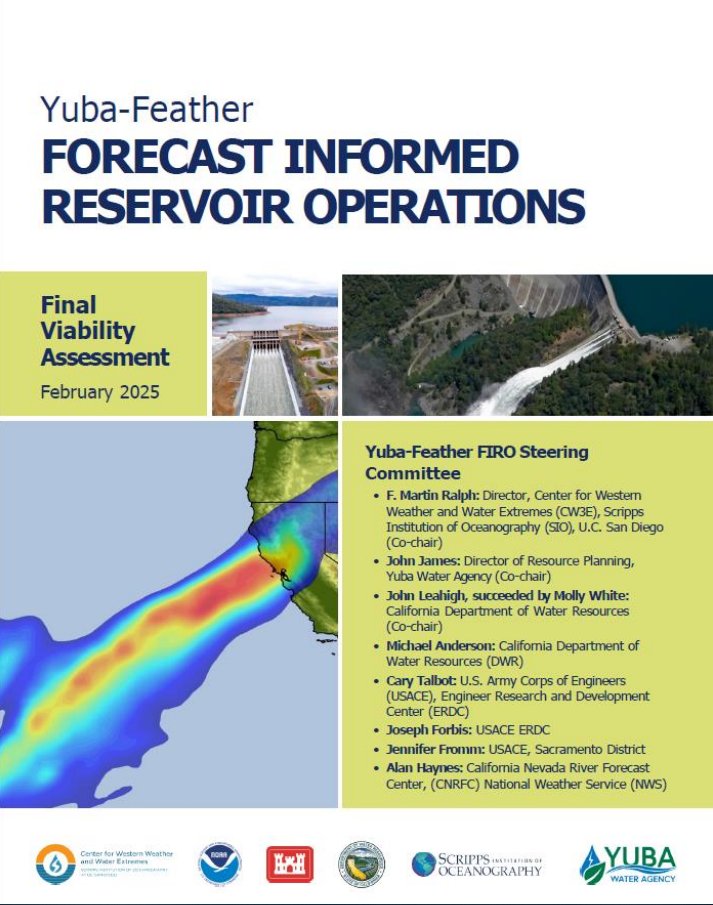
Forecast Informed Reservoir Operations
FIRO is a reservoir-operations strategy that better informs decisions to retain or release water by integrating additional flexibility in operation policies and rules with enhanced monitoring and improved weather and water forecasts (American Meteorological Society; 2020).
FIRO is being developed and tested as a collaborative effort in the Russian River Basin (Lake Mendocino, Lake Sonoma), the Santa Ana River Basin (Prado Dam, Seven Oaks Dam), the Yuba-Feather River Basins and the Green River (Howard Hanson Dam) that engages experts and stakeholders in civil engineering, hydrology, meteorology, biology, economics and climate from several federal, state and local, universities and others. There is significant interest and support for developing FIRO at other appropriate locations in the Western U.S. and elsewhere.
 |
 |
 |
 |
 |
 |
 |
 |
 |
 |
 |
 |
 |
 |
 |
 |
 |
|
Steering Committee Co-Chairs F. Martin Ralph (Center for Western Weather and Water Extremes at Scripps Institution of Oceanography) Molly White (California Department of Water Resources) John James (Yuba Water) Members Michael Anderson (California Department of Water Resources) Cary Talbot (US Army Corps of Engineers) Joseph Forbis (US Army Corps of Engineers) Jenny Fromm (US Army Corps of Engineers) Brett Whitin (California Nevada River Forecast Center) Julie Kalansky (Center for Western Weather and Water Extremes at Scripps Institution of Oceanography) Related Documents Yuba-Feather Research Fact Sheet Additional Resources |
Yuba-Feather The Yuba-Feather Rivers system has a long history of catastrophic floods. Since 1950, five major floods have resulted in 41 deaths, significant property damage, and devastating social and economic impacts. Yuba Water Agency (Yuba Water), owner and operator of New Bullards Bar (NBB) Reservoir, and the California Department of Water Resources (DWR), owner and operator of Lake Oroville, are working with the U.C. San Diego, Scripps Institution of Oceanography, Center for Western Weather and Water Extremes (CW3E) to assess the potential of Forecast-Informed Reservoir Operations (FIRO). FIRO leverages scientific improvements in forecasting of atmospheric rivers, which are responsible for more than 90 percent of the flood damages in this region, to anticipate and better manage large storm events while providing opportunities to enhance water supply. A preliminary study indicated FIRO could significantly reduce flood risks in Yuba and Sutter Counties. 
Figure 1. Map of the Yuba-Feather Rivers watersheds. Yuba-Feather FIRO builds on the Forecast-Coordinated Operations (F-CO) Program that Yuba Water and DWR created after a devastating flood in 1997. The F-CO Program seeks to improve public safety by reducing flood risk and coordinating flood operations between Lake Oroville and NBB Reservoir. F-CO includes real-time runoff forecasting and an Advance decision support system. Other members of the F-CO Program include the U.S. Army Corps of Engineers and the National Weather Service. FIRO researches opportunities to improve reservoir operations and reduce flood risks by improving weather and runoff forecasts. Atmospheric river storms cause major Yuba-Feather flood events. Understanding and better predicting regional rainfall and snow processes is fundamental to establishing forecast confidence. FIRO provides a pathway for integrating improved forecasts into reservoir operating procedures and, if shown to be viable, incorporating them into the USACE Water Control Manuals for the reservoirs. Interagency collaboration to evaluate the potential viability of FIRO is as important as the science underpinning it. Yuba Water, CW3E, and DWR will conduct FIRO within the context of existing operations and future improvements within the Yuba-Feather system. To achieve the full potential for operating Lake Oroville and NBB Reservoir under FIRO, an ongoing analysis is being conducted of the reservoirs’ release capacities. At NBB, Yuba Water is planning to construct a new high-capacity, low-level outlet (secondary spillway) to allow larger releases of water in the early stages of a storm event, preserving storage space to contain peak inflows. While DWR can already release water from Lake Oroville at low lake levels, it is also conducting a Comprehensive Needs Assessment to identify improvement priorities, appropriate solutions, and potential changes to bolster the integrity and resiliency of the Oroville Dam complex to further reduce flood risks downstream. 
Figure 2. Image of an atmospheric river that made landfall on December 2, 2012, and impacted the Yuba-Feather watersheds. 
Figure 3. Aerial images and characteristics of the Lake Oroville and New Bullards Bar Reservoirs. American Meteorological Society, cited 2020: Forecast-informed reservoir operations. Glossary of Meteorology. [Available online at http://glossary.ametsoc.org/wiki/Forecast-informed_reservoir_operations.] |